Nail Buffer vs. Nail File: Which One Do You Actually Need?
So, you’re staring at your nail care stash, and suddenly you’re hit with the age-old question: What’s the difference between a nail buffer and a nail file? And more importantly, why do I need both?
Don’t worry—you’re not alone. These two tools look kinda similar, sound kinda similar, and yet… they’re totally different beasts. Let’s break it down, no jargon allowed.
First Off: What Even Are These Things?
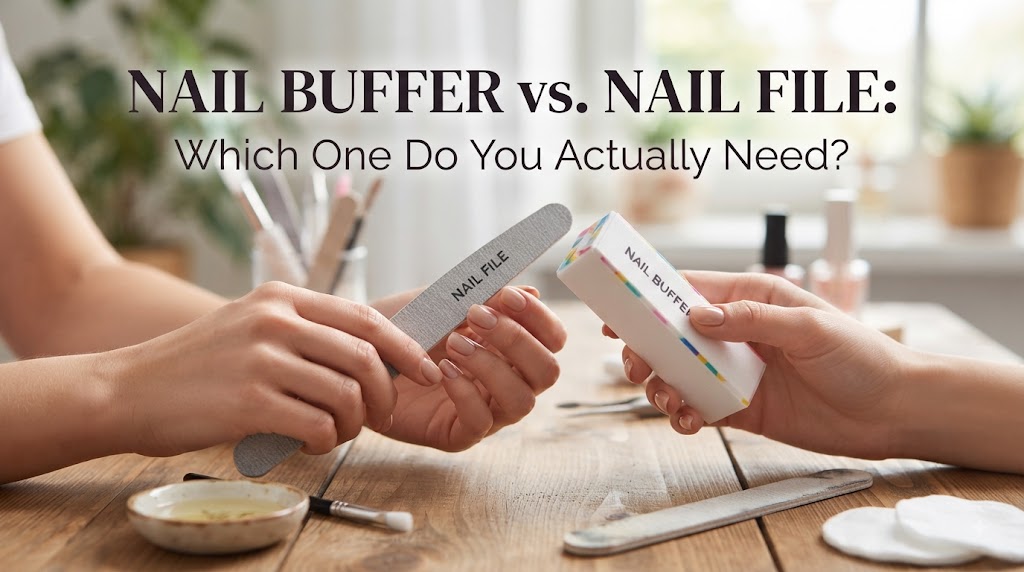
Let’s start with the basics. A Nail File looks like a flat stick (often cardboard or metal) with a gritty surface. Classic emery boards are the OGs here. It feels like Sandpaper for your nails, and its job is to trim, shorten, and shape your nails.
Also Read ➤ Emery Board vs. Nail File↗
Nail Buffer, on the other hand, looks like a chunky rectangular block (usually foam or rubber) with multiple colored sides. Fancy ones might have 3–4 different textures. It feels like A smooth operator. Less abrasive, more polisher. It smooths ridges, adds shine, and gives your nails that ~luxe glass-like finish~. It’s the detail artist.
The Big Differences: Texture, Purpose, and ✨Vibes✨
A nail file helps you shape your nails by reducing length and smoothing the edges. A nail buffer works on the nail’s surface, removing ridges and adding shine. Simply put: files shape the nail; buffers smooth and polish it. Both are essential for clean, healthy-looking natural nails.
Let’s get into why you’d grab one over the other.
1. Material & Grit Level
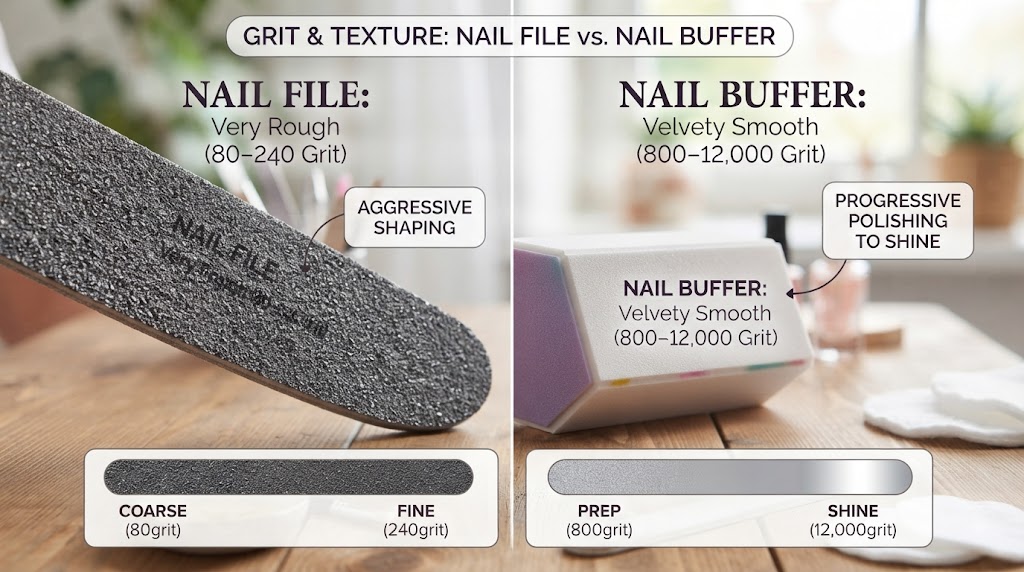
Nail File: Rough AF. The grit (abrasiveness) varies, but most files have a texture like 80–240 grit sandpaper. The lower the number, the more aggressive the file.
Pro tip: Coarse grit for thick nails, fine grit for thin or brittle nails.
Nail Buffer: Way smoother. Buffers have a higher grit (think 800–12,000) and feel almost velvety. Each side of the buffer gets progressively finer to polish nails to high-shine heaven.
2. What They’re Used For
- Nail File:
- Shaping: Turning talon-like claws into chic squares, almonds, or coffins.
- Shortening: Cutting down length without clippers (just file back and forth).
- Smoothing snags: Fixing a cracked edge or jagged spot quickly.
- Not great for: Making nails shiny. You’ll just sand them into oblivion.
- Nail Buffer:
- Smoothing ridges: Got bumpy nails? Buffers flatten the surface.
- Adding shine: Buffing creates friction + heat, which smooths the nail’s layers into a glossy finish.
- Prepping for polish: A buffed nail helps polish adhere better.
- Not great for: Major length changes. You’ll be buffing for hours.
3. How You Use Them?
File Moves: File in one direction only (usually center to edge). Sawing back and forth can cause splits.
Buffer Moves: Gentle circles or back-and-forth swipes. Use the coarsest side first, then work up to the smoothest for maximum shine.
When to Use Each (Because Timing is Everything)
- Reach for the file when:
- Your nails are freshly trimmed and need shaping.
- You have a ~nail emergency~ (snag, break, or sharp edge).
- You’re prepping for extensions or press-ons.
- Grab the buffer when:
- Your nails are shaped but look dull or have ridges.
- You want a natural “my nails but better” glossy look.
- You’re applying polish and need a smooth base.
Bonus hack: Some buffers have a “shine” side that’s basically magic. Use it weekly to keep nails looking salon-fresh.
Common Mistakes (Don’t Be That Person)
- Over-buffing: Buffing too hard or too often thins your nails, making them weak. Less is more!
- Using a file like a saw: Back-and-forth filing = splinter city. Stick to one direction.
- Ignoring grit levels: Using a coarse file on thin nails? RIP. Match the tool to your nail’s needs.
- Skipping cleaning: Buffers and files collect dead skin and bacteria. Sanitize them with alcohol occasionally.
Can You Use Them Together? (Spoiler: Yes!)
The dream team:
- File first to shape and shorten.
- Buff next to smooth and shine.
This combo gives you that chef’s kiss manicure without polish. Proceed to flex your glossy, healthy-looking nails.
Buffing vs. Filing: FAQs (Because You’re Still Curious)
Q: Can a buffer replace a file?
A: Nope. Buffers can’t shorten or reshape nails effectively. They’re the icing, not the cake.
Q: Do buffers damage nails?
A: Only if you go HAM. Gentle buffing 1–2x a month is safe.
Q: Why does buffing make nails shiny?
A: Science! The friction smoothes the nail’s keratin layers, reflecting light like a mirror.
Q: Are glass files better than emery boards?
A: Glass/crystal files are finer and last longer, but emery boards are cheap and disposable. Your call!
The Verdict: Do You Need Both?
If you’re a minimalist: Yes, actually. They do different jobs, and skipping one means compromising your nail game.
But if you really wanna pick one? Prioritize the file for maintenance. Buffing is a luxury, but filing is a necessity.
TL;DR
- Nail File = Sculptor (shape, shorten, fix).
- Nail Buffer = Magician (smooth, shine, perfect).
- Use both for Insta-worthy nails.
Now go forth and flex those glossy, perfectly shaped tips! ????✨
Got questions? Drop ’em below! And share your nail care wins (or fails—we’ve all been there).
